
Most pre-retirees follow the traditional retirement playbook: max out your 401(k), wait decades, then withdraw during retirement while paying whatever tax rates exist at that time.
But there may be a smarter approach that could potentially save high-net-worth retirees hundreds of thousands in lifetime taxes. It’s called the 5-Year Roth Ladder Strategy, and it’s one of the most underused tax optimization tools in retirement planning today.
The 5-Year Roth Ladder Strategy is a methodical approach to converting pre-tax retirement dollars into tax-free wealth by systematically moving money from traditional retirement accounts into Roth IRAs over a series of annual conversions, while keeping each year’s conversion within a target tax bracket to minimize the immediate tax burden.
By thoughtfully building savings in different account types, retirees give themselves more tools to adapt to changing circumstances (such as the everchanging healthcare system), control taxable income, and make their money last longer.
How Does the 5-Year Roth Ladder Strategy Work Step by Step?
The Roth ladder conversion process follows five sequential steps.
First, you calculate your optimal annual conversion amount. This means determining exactly how much to convert each year so you stay within your target federal tax bracket without spilling into the next one.
Second, you execute the conversion by moving funds from your traditional 401(k) or Traditional IRA into a Roth IRA.
Third, you pay the conversion taxes, ideally from non-retirement assets like a taxable brokerage account so your full converted balance continues to grow tax-free inside one Roth.
Fourth, you wait five years. Each individual conversion must “season” for five years before it becomes eligible for penalty-free withdrawal. This is known as the Roth five-year rule, and it applies separately to each conversion.
Fifth, after the five-year waiting period, you access your converted amounts completely tax-free. regardless of your age at the time of the withdrawal.
Why Does the 5-Year Roth Ladder Matter for High-Net-Worth Pre-Retirees?
For professionals with $1M or more in pre-tax retirement accounts, Required Minimum Distributions (RMDs) starting at age 73 can force you into significantly higher tax brackets during retirement. This creates a compounding tax problem that many people don’t see coming until it’s too late.
Here’s a real-world example of how the Roth ladder strategy works in practice.
A 57-year-old executive had $1.5M in traditional retirement accounts. Without intervention, her projected RMDs starting at age 73 would exceed $95,000 annually, pushing her deep into the 32% federal tax bracket. By implementing a 15-year Roth ladder strategy and converting $80,000 per year while remaining in the 24% bracket, she is projected to save over $287,000 in lifetime taxes while simultaneously creating a tax-free inheritance for her children.
What Tax Optimization Details Do Most Financial Advisors Miss About Roth Conversions?
There are four commonly overlooked dimensions of Roth ladder planning that separate basic advice from truly sophisticated tax strategy.
Tax bracket management means converting just enough each year to “fill up” lower tax brackets without triggering the next marginal rate. This requires precise annual income projections that account for all income sources, not just retirement withdrawals.
Healthcare premium protection involves structuring conversions so that your Modified Adjusted Gross Income (MAGI) does not trigger Medicare IRMAA surcharges. IRMAA stands for Income-Related Monthly Adjustment Amount, and it can add thousands in annual Medicare premiums if your income exceeds certain thresholds during the two-year lookback period.
Conversion timing is about accelerating conversions during market downturns. When account values are temporarily depressed, you convert the same number of shares at a lower dollar value, paying less in conversion taxes while capturing the full recovery inside the tax-free Roth account.
State tax arbitrage applies when you’re planning a relocation from a high-income-tax state to a low-tax or no-income-tax state. By timing large conversions to occur after the move, you can save significantly on state taxes owed on those conversions.
Who Is the 5-Year Roth Ladder Strategy Best For?
The Roth ladder conversion strategy works best for people who have at least five years before they need to access to converted funds, who can pay the conversion taxes from non-retirement assets, who expect to face equal or higher tax rates in retirement than they pay today, who want to reduce or eliminate Required Minimum Distributions on converted amounts, and who want to leave tax-free wealth to heirs through inherited Roth IRAs.
What Is the Difference Between a Roth Ladder and a Standard Roth Conversion?
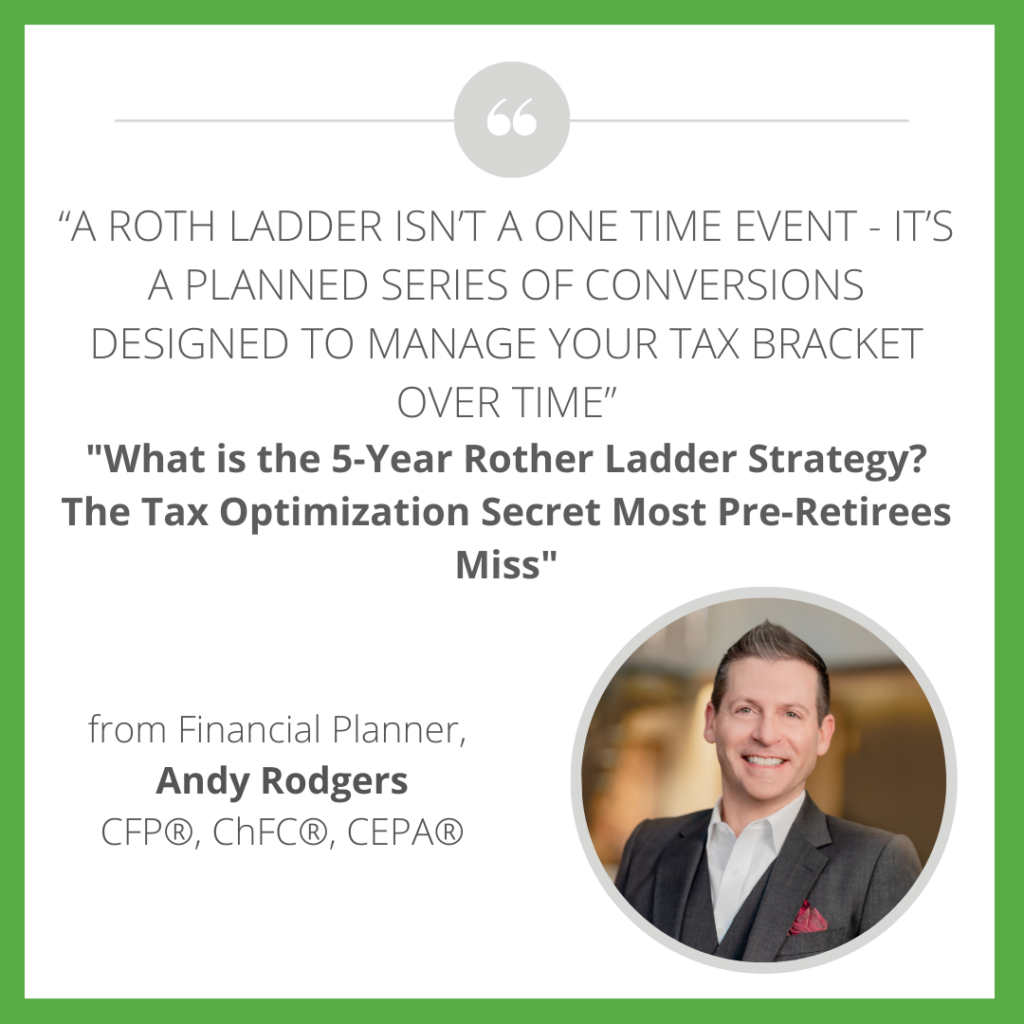
A standard Roth conversion is a one-time event where you move money from a traditional retirement account to a Roth IRA. A Roth ladder is a planned series of annual conversions spread across multiple years, specifically designed to manage your tax bracket exposure over time. The “ladder” refers to the staggered five-year seasoning periods for each conversion, which create a rolling schedule of funds becoming available for tax-free and penalty-free withdrawal.
While traditional financial advisors often focus heavily on accumulation strategies during your working years, the truly sophisticated retirement plan requires equal or greater attention to tax-efficient distribution planning in the decade before and after retirement.
If this breakdown was valuable, follow our profile for more advanced retirement tax strategies that most advisors aren’t discussing. We specialize in helping pre-retiree professionals with $1M+ in retirement assets structure their distribution plans to maximize after-tax wealth and create lasting financial confidence.
Andy Rogers, CFP®, ChFC®, CEPA®
CERTIFIED FINANCIAL PLANNER
Mainspring Wealth Advisors, LLC